


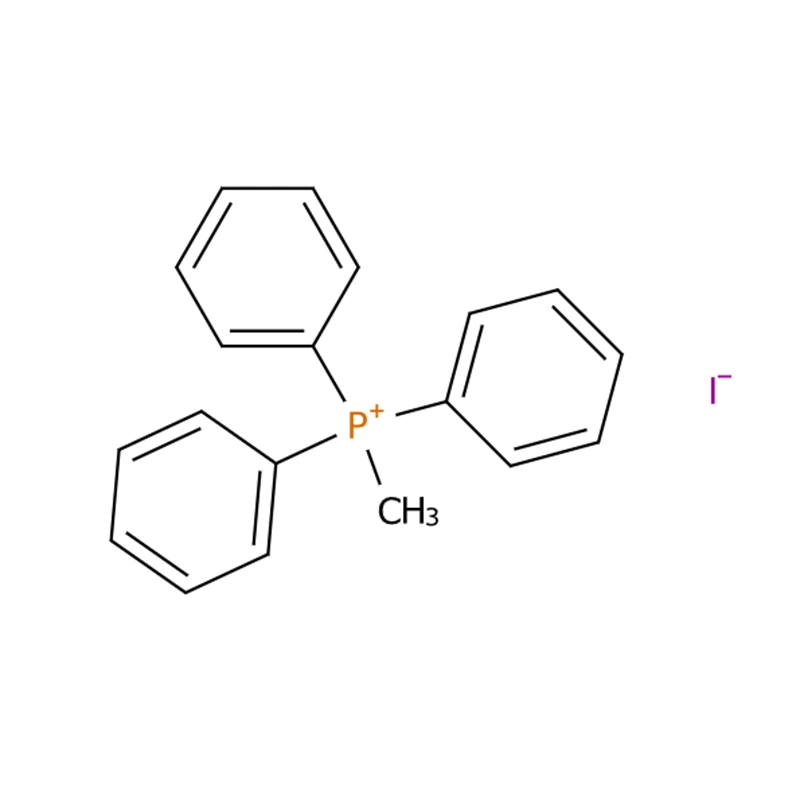
Methyltriphenylphosphonium iodide CAS#2065-66-9
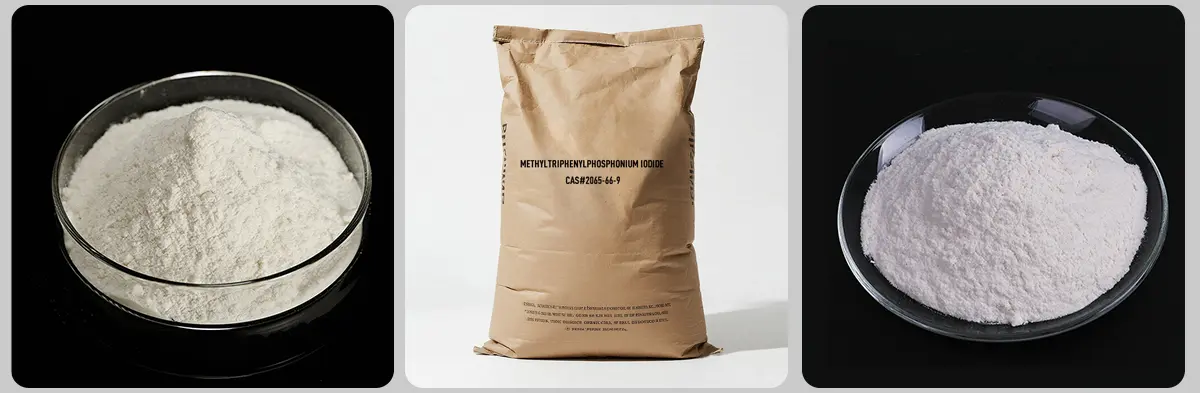
Methyltriphenylphosphonium iodide is an organophosphorus substance with the molecular formula C₁₉H₁₈IP and molecular weight of 404.22, registered under CAS number 2065-66-9. This product generally comes in white powder form; its alternative designation is triphenylmethylphosphonium iodide. It features a melting point ranging from 183 to 188 °C (accompanied by decomposition) and a flash point of 235 °C.
Methyltriphenylphosphonium iodide Chemical Properties
| Melting point | 183-185 °C(lit.) |
| storage temp. | Keep in dark place,Inert atmosphere,Room temperature |
| solubility | Chloroform (Slightly), Methanol (Slightly) |
| form | Powder |
| color | White to light yellow |
| Water Solubility | SOLUBLE |
| Sensitive | Light Sensitive & Hygroscopic |
| InChI | InChI=1S/C19H18P.HI/c1-20(17-11-5-2-6-12-17,18-13-7-3-8-14-18)19-15-9-4-10-16-19;/h2-16H,1H3;1H/q+1;/p-1 |
| InChIKey | JNMIXMFEVJHFNY-UHFFFAOYSA-M |
| SMILES | [P+](C)(C1=CC=CC=C1)(C1=CC=CC=C1)C1=CC=CC=C1.[I-] |
| CAS DataBase Reference | 2065-66-9(CAS DataBase Reference) |
Safety Information
| Hazard Codes | Xi,T |
| Risk Statements | 36/37/38-25 |
| Safety Statements | 26-36-45-37/39-28A |
| RIDADR | UN3464 |
| WGK Germany | 3 |
| HazardClass | 6.1 |
| PackingGroup | III |
| HS Code | 29319090 |

Product Application of Methyltriphenylphosphonium iodide CAS#2065-66-9
Its main application lies within organic synthesis. It is deployed to fabricate pyrene-modified polyolefin materials intended for dye-sensitized solar cells, and also serves catalytic routes targeting carbasugar and alkaloid synthesis. Besides, it takes part in transformations such as the conversion of olefins into carbene intermediates, alongside dehydrogenative halogenation-Heck coupling reactions. For proper preservation, the material requires light shielding and storage under an argon blanket.