


Products Description of 2,2,6,6‑Tetramethylpiperidinooxy (CAS#2564‑83‑2)
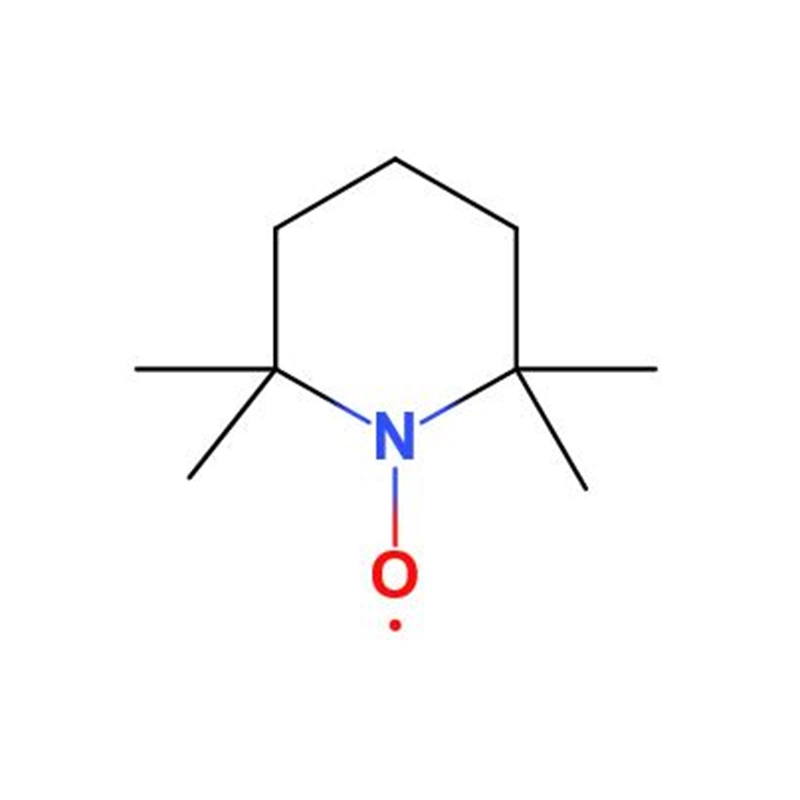
2,2,6,6‑Tetramethylpiperidinyl oxide, widely known by its shorthand TEMPO, belongs to the class of piperidine nitroxide radicals. It exists as orange‑red crystalline or liquid material with notable sublimation properties, and it shows good miscibility in water, ethanol, benzene and other similar solvents.
TEMPO delivers strong performance for free‑radical scavenging and singlet‑oxygen suppression. Moreover, it functions as a high‑efficiency oxidation catalyst, carrying out selective oxidation that converts primary alcohols into aldehydes and secondary alcohols into ketones.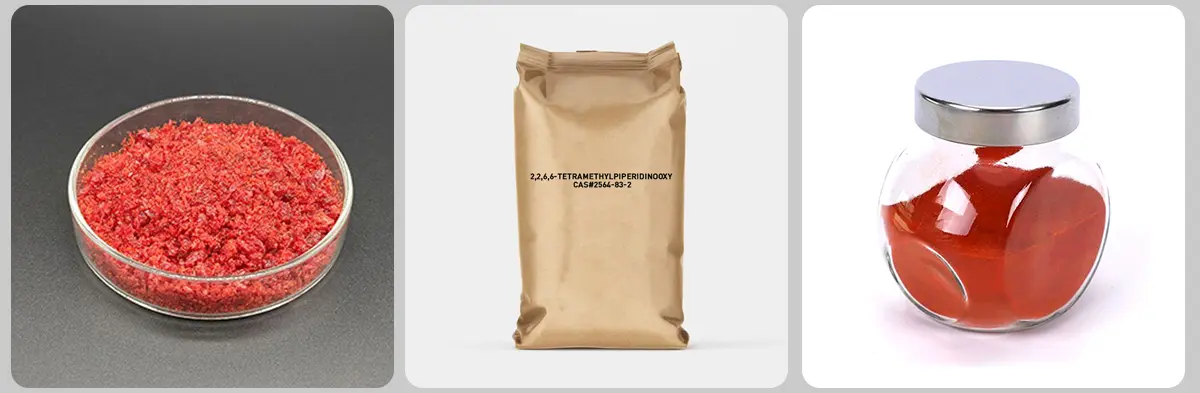
2,2,6,6-Tetramethylpiperidinooxy Chemical Properties
| Melting point | 36-38 °C(lit.) |
| Boiling point | 193°C |
| Density | 1 g/cm3 |
| Vapor pressure | 0.4 hPa (20 °C) |
| Refractive index | 1.4350 (estimate) |
| Fp | 154 °F |
| Storage temp | Store below +30°C. |
| Solubility | 9.7g/l |
| Form | Powder |
| Color | Yellow to green |
| PH | 8.3 (9g/l, H2O, 20℃) |
| Water Solubility | Soluble in all organic solvents. Insoluble in water. |
| Merck | 149140 |
| BRN | 1422418 |
| Stability: | Stable. Incompatible with strong acids, strong oxidizing agents. Refrigerate. |
| InChIKey | RVWUHFFPEOKYLB-UHFFFAOYSA-N |
| CAS DataBase Reference | 2564-83-2(CAS DataBase Reference) |
| NIST Chemistry Reference | 1-Piperidinyloxy, 2,2,6,6-tetramethyl-(2564-83-2) |
| EPA Substance Registry System | 1-Piperidinyloxy, 2,2,6,6-tetramethyl- (2564-83-2) |
Safety Information
| Hazard Codes | C,Xi |
| Risk Statements | 34-36/37/38 |
| Safety Statements | 26-36/37/39-45-24/25 |
| RIDADR | UN 3263 8/PG 2 |
| WGK Germany | 3 |
| RTECS | TN8991900 |
| Autoignition Temperature | 275 °C |
| TSCA | Yes |
| HazardClass | 8 |
| PackingGroup | III |
| HS Code | 29333999 |
Product Application of 2,2,6,6‑Tetramethylpiperidinooxy (CAS#2564‑83‑2)
TEMPO finds broad applications across chemical research, biological studies, food processing, agriculture and numerous other sectors. It acts simultaneously as a radical scavenger, singlet‑oxygen quencher and selective oxidation catalyst.
Within polymer science, it serves as a radical trap, polymerization inhibitor, anti‑degradation additive and stabilizer against thermal, light‑induced deterioration. It is capable of bonding with reactive chain radicals to generate covalently capped dormant intermediates. These species can cleave again to release active radicals and resume chain propagation.
For organic synthesis workflows, TEMPO is a popular catalytic choice for oxidizing alcohols and polyols. It achieves selective conversion of primary alcohols into aldehydes, avoiding over‑oxidation into carboxylic acids, while secondary alcohols are transformed into ketones. The TEMPO/NaClO/NaBr combination represents a recyclable oxidation system. The real oxidative agent in this setup is the N‑oxoammonium cation generated by NaClO oxidation of TEMPO. During this cyclic reaction, hydroxyl groups undergo oxidation, and TEMPO is regenerated by the co‑oxidant to sustain continuous and efficient oxidation. A wide array of alternative TEMPO‑based oxidation systems are also widely adopted for synthetic work.