
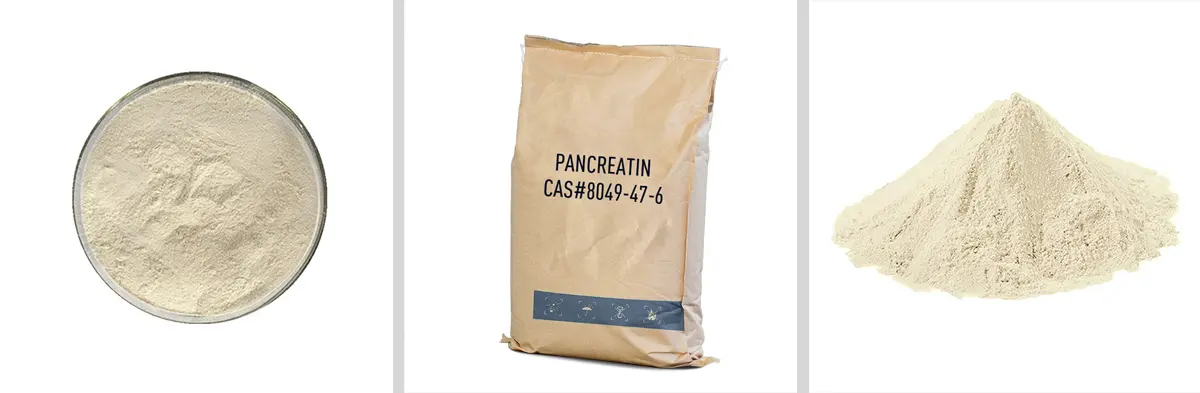
Pancreatin CAS#8049-47-6
Pancreatin is extracted from fresh porcine or bovine pancreatic tissue and consists of an enzyme mixture dominated by pancreatic amylase (amylopsin), proteases and pancreatic lipase (steapsin). It can convert no less than 25 times its own weight of USP potato starch standard into soluble carbohydrates, and break down at least 25 times its weight of casein into proteoses. Its catalytic activity peaks under neutral or faintly alkaline conditions; overly acidic or alkaline surroundings will deactivate these enzymes.
This product is commonly produced by leaching fresh pancreatic glands with 25% ethanol or water, followed by ethanol precipitation. Besides the main active enzymes, it also contains zymogens: trypsinogen, which becomes activated by enterokinase from the intestine, chymotrypsinogen, transformed into chymotrypsin under the action of trypsin, and carboxypeptidase.
Pancreatin is widely applied for pre-digestion of food materials and the manufacture of hydrolysates. Nevertheless, its enzymatic efficacy after oral administration is subject to restrictions. The contained enzymes can be degraded by pepsin and gastric acid, though a fraction may transit intact into the intestinal tract. Even with enteric coating protection, its overall digestive assisting effect remains relatively limited.
Pancreatin Chemical Properties
| Bulk density | 400kg/m3 |
| Density | 1.4-1.52 |
| Vapor pressure | 0Pa at 25℃ |
| Storage temp | -20°C |
| Solubility | Soluble or partly soluble in water forming a slightly turbid solution; practically insoluble in ethanol (96%) and in ether . |
| Form | powder |
| Color | beige |
| PH | 5-6 (20°C, 10g/L in H2O) |
| Biological source | Porcine pancreas |
| Water Solubility | Soluble in water. Insoluble in alcohol and ether. |
| Merck | 137075 |
| Specific Activity | 8× USP specifications |
| Stability | Stable. Incompatible with alcohols, strong acids. |
| Cosmetics Ingredients Functions | HAIR CONDITIONING |
| SKIN CONDITIONING | |
| LogP | -1.3 at 20℃ and pH5.7-5.8 |
| EPA Substance Registry System | Pancreatin (8049-47-6) |
Safety Information
| Hazard Codes | Xn |
| Risk Statements | 36/37/38-42-42/43 |
| Safety Statements | 22-24-26-36/37-37/39 |
| WGK Germany | 1 |
| RTECS | RT9033000 |
| F | 46091 |
| Autoignition Temperature | >360°C |
| TSCA | TSCA listed |
| HS Code | 35079090 |
| Storage Class | 13 - Non Combustible Solids |
| Hazard Classifications | Eye Irrit. 2 |
| Resp. Sens. 1 | |
| Skin Irrit. 2 | |
| Skin Sens. 1 | |
| STOT SE 3 | |
| Hazardous Substances Data | 8049-47-6(Hazardous Substances Data) |
| Toxicity | LD50 orl-rat: >10 g/kg YACHDS 3,2427,75 |
Product Application of Pancreatin CAS#8049-47-6
Pancreatin catalyzes the hydrolysis of starch into dextrins and saccharides. The pancreatin extracted from porcine pancreas is adopted for lipase replacement therapy to manage steatorrhea and pancreatic diabetes. It is also deployed to eliminate formalin-fixed tissues on arterial grafts while preserving the structural integrity of fibers, and it finds further utilization in contact lens-related processing.
In addition, pancreatin serves for the management of illnesses caused by inadequate pancreatic secretion, including post-pancreatectomy cases, pancreatitis and cystic fibrosis.