
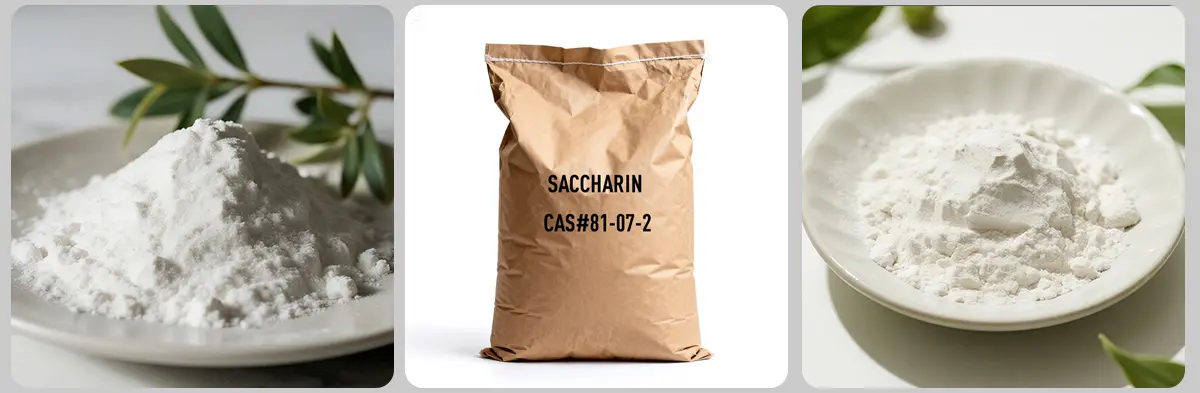
Product Description of Saccharin (CAS No. 81-07-2)
Pure saccharin is a non-toxic, calorie-free and non-nutritive sweetener that cannot be absorbed by the human body. Thanks to its sweet sensory property, it is extensively adopted as a sugar replacer within food formulations. As a permitted food additive, it delivers sweet flavor without supplying nutritional calories, satisfying market demand for sugar-free food items. Commercial saccharin is mostly supplied in the form of its sodium derivative, generally referred to as sodium saccharin.
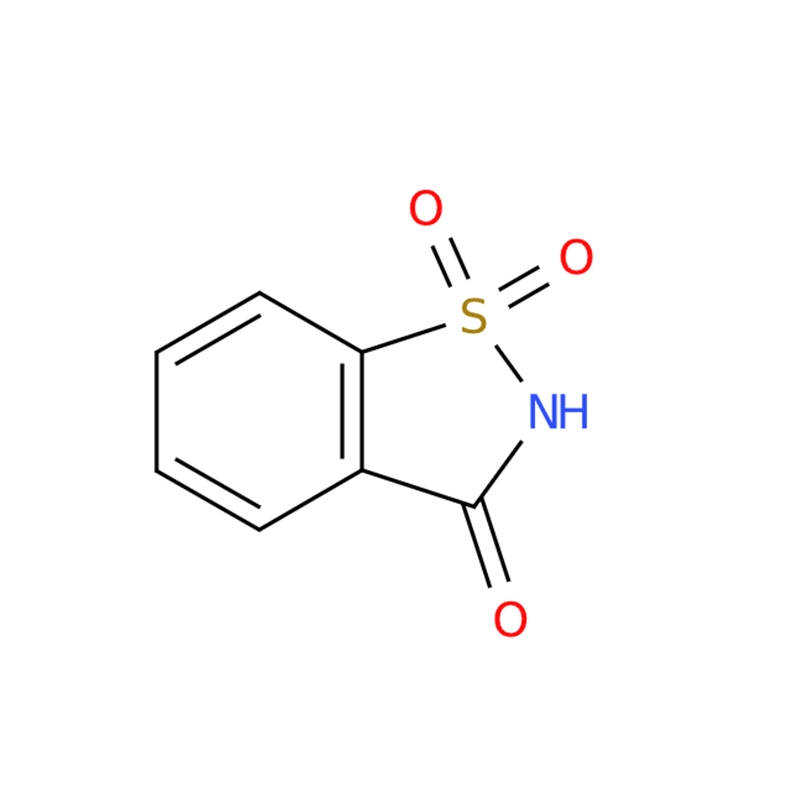
Saccharin Chemical Properties
| Melting point | 226-229 °C (lit.) |
| Boiling point | subl |
| Density | 0.828 |
| Vapor pressure | 0Pa at 25℃ |
| Refractive index | 1.5500 (estimate) |
| Storage temp | Store below +30°C. |
| Solubility | acetone: soluble1g in 12mL(lit.) |
| Pka | 11.68(at 18℃) |
| Form | Crystals or Crystalline Powder |
| Color | White |
| Odor | odorless |
| Water Solubility | 3.3 g/L (20 ºC) |
| Merck | 148311 |
| BRN | 6888 |
| Stability | Stable. Incompatible with strong oxidizing agents. |
| InChIKey | CVHZOJJKTDOEJC-UHFFFAOYSA-N |
| LogP | -0.024 at 25℃ |
| CAS DataBase Reference | 81-07-2(CAS DataBase Reference) |
| IARC | 3 (Vol. Sup 7, 73) 1999 |
| NIST Chemistry Reference | Saccharin(81-07-2) |
| EPA Substance Registry System | Saccharin (81-07-2) |
Safety Information
| Risk Statements | 40-62-63-68 |
| Safety Statements | 24/25 |
| RIDADR | UN 3077 9/PG 3 |
| WGK Germany | 2 |
| RTECS | DE4200000 |
| TSCA | Yes |
| HazardClass | IRRITANT |
| HS Code | 29251100 |
| Hazardous Substances Data | 81-07-2(Hazardous Substances Data) |
| Toxicity | LD50 oral in mouse: 17gm/kg |
Product Applications of Saccharin (CAS No. 81-07-2)
Saccharin, alternatively named o‑benzoylsulfonyl imide, serves as a synthetic intermediate for agrochemicals including fungicides and herbicides. Target products in this category cover allylthiazole, metsulfuron‑methyl, bensulfuron‑methyl, ethametsulfuron‑methyl and chlorimuron‑methyl.
It also acts as a non‑nutritive sweetener, which is usually formulated into its sodium or ammonium salt variants. Its relatively slow dissolution rate inside the oral cavity makes it especially fit for chewing gum applications, with a maximum permitted dosage of 0.05 g/kg under the Japanese standard issued in 1998.
Beyond the above uses, saccharin supports the fabrication of pesticide intermediates and sodium saccharin, and can be added to formulations to deliver sweet flavor for mammalian targets. Moreover, it exhibits inhibitory activity against phosphotransferase and phosphohydrolase, and finds analytical uses such as the detection of thallium.