


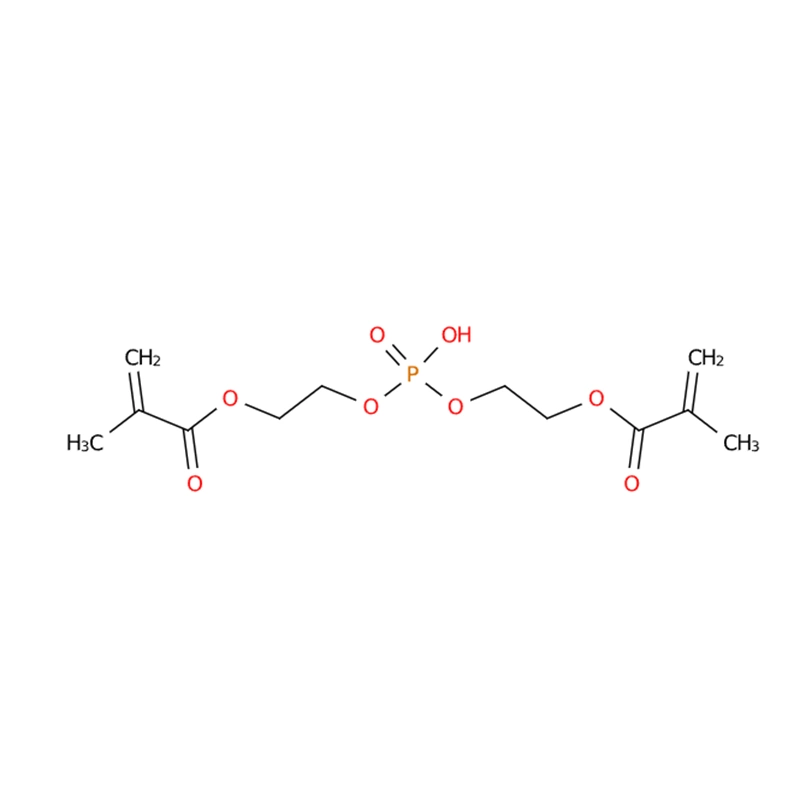
Products Description of BIS(2-Methacryloxyethyl)phosphate CAS#32435-46-4
Bis(2-Methacryloxyethyl)phosphate (CAS# 32435-46-4) is a hydrophilic difunctional monomer with the molecular formula C₁₂H₁₉O₈P. Its molecular structure incorporates two polymerizable methacrylate groups together with a phosphate group, granting it flexible reactive characteristics. This substance is frequently applied as a coupling agent and adhesion enhancer within dental resin formulations. It also serves as an essential starting material for developing flame-retardant polymers and superabsorbent polymers.

BIS(2-METHACRYLOXYETHYL) PHOSPHATE Chemical Properties
| Boiling point | 221 °C(lit.) |
| Density | 1.28 g/mL at 25 °C(lit.) |
| Refractive index | n20/D 1.47(lit.) |
| Fp | >230 °F |
| Storage temp | 2-8°C |
| Pka | 1.29±0.50(Predicted) |
| EPA Substance Registry System | 2-Propenoic acid, 2-methyl-, phosphinicobis(oxy-2,1-ethanediyl) ester (32435-46-4) |
| Hazard Codes | Xi |
| Risk Statements | 36/37/38 |
| Safety Statements | 26-36 |
| WGK Germany | 3 |
| HS Code | 29199000 |

Applications & Properties
Dental Materials: Used as a monomer in self-etching primer formulations for enamel and dentine.
Polymer Science: Acts as a crosslinker to synthesize superabsorbent polymers (SAPs) and fire-retardant nanocomposites.
Reactivity: Exhibits high degrees of conversion during polymerization.