

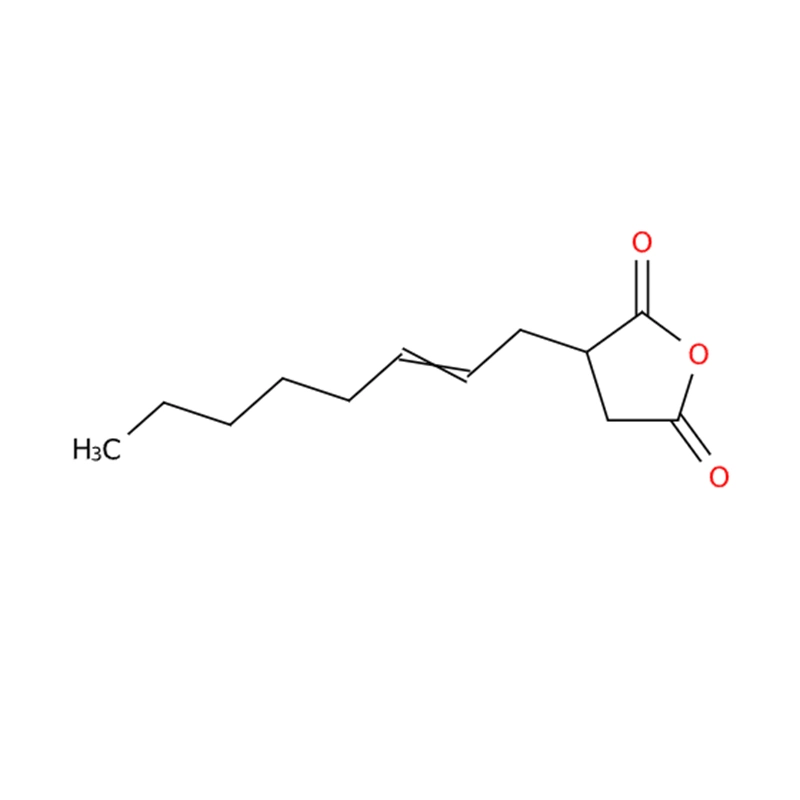
Product Description 2-Octen-1-ylsuccinic Anhydride CAS#42482-06-4
2‑Octen‑1‑ylsuccinic anhydride is a reactive anhydride‑type synthetic precursor and is commercially offered as a blend of cis and trans isomers.
It receives broad application in organic synthesis, polymer modification, resin manufacturing, adhesive blending and specialty chemical production. The reactive anhydride functional group endows it with favorable reactivity, making it suitable for surface treatment, copolymer preparation and the development of performance additives.
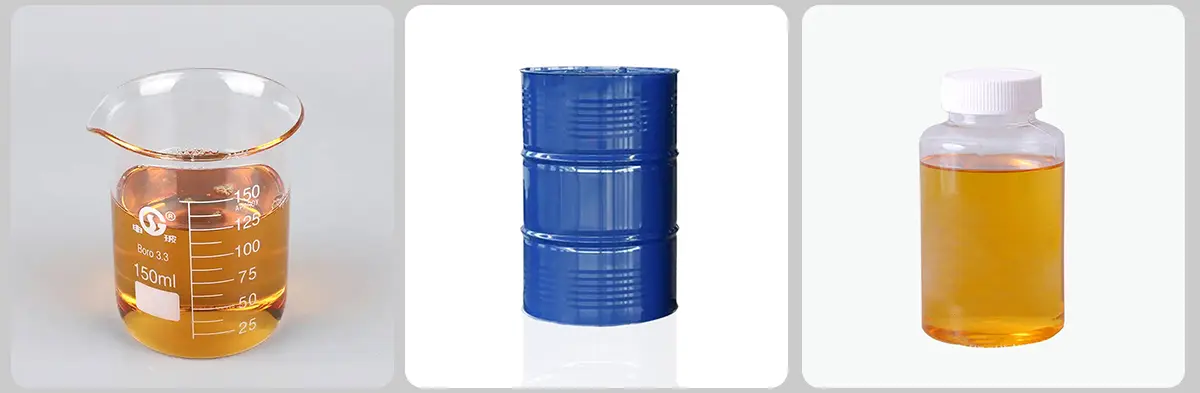
2-Octen-1-ylsuccinic anhydride, mixture of cis and trans Chemical Properties
| Melting point | 8-12°C (lit.) |
| density | 1 g/mL at 25 °C(lit.) |
| vapor pressure | 43.5Pa at 20℃ |
| refractive index | n20/D1.4694(lit.) |
| Fp | 113℃ |
| form | Viscous |
| color | Colorless to Almost colorless |
| Boiling point | 168°C/10 mmHg(lit.) |
| LogP | 4.68 at 22℃ and pH7 |
| EPA Substance Registry System | 2,5-Furandione, dihydro-3-(2-octenyl)- (42482-06-4) |
| Safety Information | |
| Hazard Codes | Xi |
| Risk Statements | 36/38 |
| Safety Statements | 26-36 |
| WGK Germany | 3 |
| HS Code | 29171900 |
Product Applications
Organic Synthesis Intermediate – It serves as a reactive building block extensively adopted for custom specialty chemicals and fine‑chemical synthetic routes.
Polymer Modification – It is suitable for polymer grafting, copolymerization and functional material development, to upgrade surface characteristics and mechanical performance.
Resin Manufacturing – Deployed for preparing and modifying high‑performance resins, bringing better compatibility and greater formulation flexibility.
Adhesive and Sealant Systems – It acts as a functional precursor in adhesive blends, improving bonding strength and manufacturing efficiency.
Specialty Coatings – Used as a coating additive and surface conditioning agent for performance‑optimized formulations.
Material R&D – Well suited for laboratory trials, pilot tests and commercial production of customized functional materials.