

Products Description of Prussian Blue CAS#14038-43-8
Prussian Blue, also known as Berlin Blue, Gong Blue, Iron Blue, Milori Blue, Chinese Blue, and Hualan, is an ancient blue pigment widely used in glazing and oil painting. Its distinctive blue color and unique precipitated texture give it exceptional visual appeal.
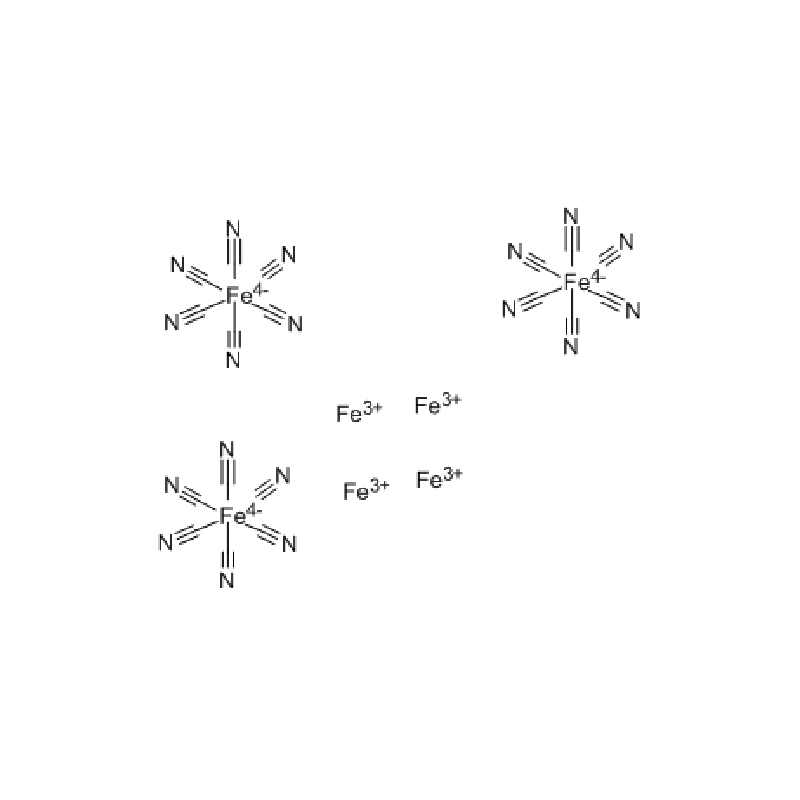
Discovered in 1706, Prussian Blue is a blue pigment with a structure composed of Fe(II) and Fe(III) coordinated with cyano (-CN-) groups. As a coordination polymer, it exhibits excellent magnetic, electrical, and optical properties, with its magnetic energy following Curie's law in the range of 200–300 K.
In electrochemical applications, Prussian Blue serves as an effective electron-transfer medium. Iron ions in different valence states can transfer electrons to each other through cyano groups, resulting in characteristic absorption bands at approximately 680 nm and 400 nm, which contribute to its distinctive blue color.
The presence of mixed-valence iron also gives Prussian Blue multiple redox states and enables the formation of different color forms, including Prussian White, Berlin Green, and Prussian Yellow. In particular, the FDA approved Prussian Blue as an antidote for thallium and cesium poisoning in 2003. This recognition of its biosafety generated significant research interest and contributed to advances in biomedical applications.
Prussian Blue Chemical Properties
| density | 1.8 |
| storage temp. | Room Temperature |
| solubility | insoluble in H2O, dilute acid solutions, organic solvents |
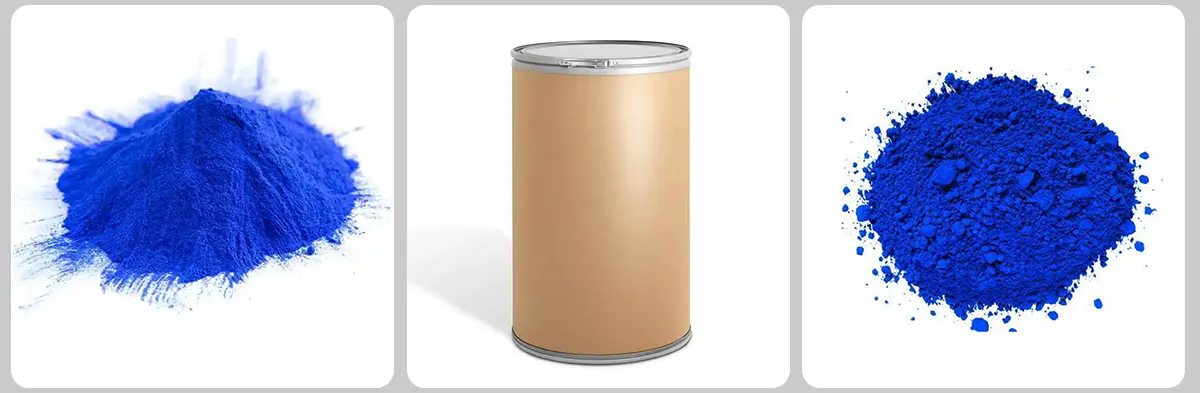
| form | Powder |
| color | Dark blue |
| Water Solubility | practically insoluble |
| Sensitive | Hygroscopic |
| Merck | 147910 |
| Solubility Product Constant (Ksp) | pKsp: 40.52 |
| Exposure limits | ACGIH: TWA 1 mg/m3 |
| NIOSH: IDLH 25 mg/m3; TWA 1 mg/m3 | |
| Stability: | Stable. Incompatible with strong acids, strong oxidizing agents, ammonia. Light sensitive. |
| InChI | InChI=1S/18CN.7Fe/c18*1-2;;;;;;;/q;;;;;;;;;;;;;;;;;;3*-4;4*+3 |
| InChIKey | DNMNDNSFJMUUFM-UHFFFAOYSA-N |
| SMILES | [Fe-4](C#N)(C#N)(C#N)(C#N)(C#N)C#N.[Fe-4](C#N)(C#N)(C#N)(C#N)(C#N)C#N.[Fe-4](C#N)(C#N)(C#N)(C#N)(C#N)C#N.[Fe+3].[Fe+3].[Fe+3].[Fe+3] |
| LogP | -0.250 (est) |
| EPA Substance Registry System | Iron ferrocyanide (Fe4[Fe(CN)6]3) (14038-43-8) |
| Safety Statements | 22-24/25 |
| WGK Germany | 1 |
| RTECS | LJ8200000 |
| TSCA | Yes |
| HS Code | 32041990 |
| Hazardous Substances Data | 14038-43-8(Hazardous Substances Data) |
| Toxicity | mouse,LD,oral,> 8gm/kg (8000mg/kg),Gigiena Truda i Professional'nye Zabolevaniya. Labor Hygiene and Occupational Diseases. Vol. 35(1), Pg. 35, 1991. |

Product Application of Prussian Blue CAS#14038-43-8
Prussian Blue is a dark blue pigment widely used in paints, inks, drawings, and crayons. It is also used for coloring varnished fabrics, paper, plastics, and other materials.