


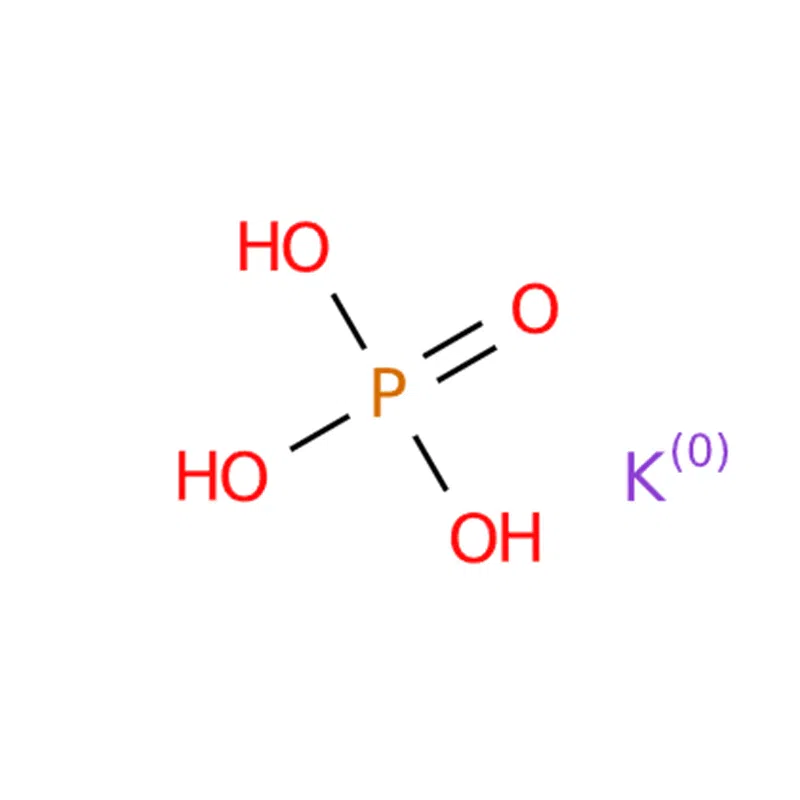
Product Description of Potassium Phosphate CAS#778-53-2
Potassium phosphate is a high-performance buffering reagent frequently deployed for pH modulation. It is a routine ingredient incorporated into multiple microbial culture media and phosphate-buffered saline (PBS) formulations.
Potassium phosphate has multiple species, namely monobasic, dibasic and tribasic potassium phosphate (K₃PO₄). The majority of near-neutral potassium phosphate buffer mixtures are formulated by blending monobasic and dibasic salts at varied ratios to meet target pH requirements.
Gomori buffer is among the most prevalent phosphate buffer systems, consisting of monopotassium dihydrogen phosphate and dipotassium monohydrogen phosphate. Tuning the proportion of these two phosphate salts yields buffer solutions with reliable buffering activity spanning pH 5.8 to 8.0. Thanks to its remarkable buffering strength and favorable water solubility, potassium phosphate fits well into numerous biochemical assays and laboratory operations.
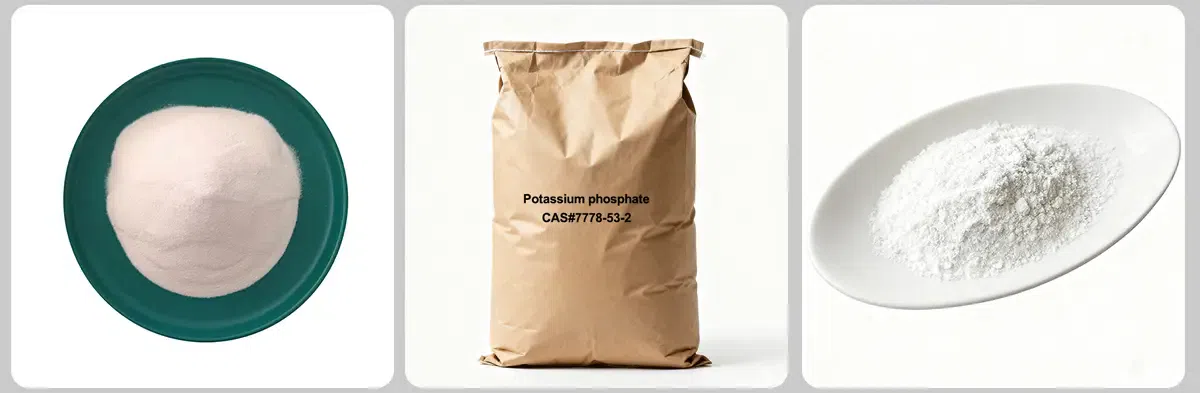
Potassium phosphate tribasic Chemical Properties
Melting point | 1340 °C |
density | 2.564 g/mL at 25 °C(lit.) |
vapor pressure | 0Pa at 20℃ |
storage temp. | room temp |
solubility | water: soluble100mg/mL, clear, colorless |
form | Solid |
Specific Gravity | 2.564 |
color | White |
Odor | at 100.00?%. odorless |
Water Solubility | 50.8 g/100 mL (25 ºC) |
Sensitive | Hygroscopic |
Merck | 147660 |
BCS Class | 1 |
Stability: | Stable. Incompatible with strong oxidizing agents, moisture. |
CAS DataBase Reference | 7778-53-2(CAS DataBase Reference) |
EPA Substance Registry System | Tripotassium phosphate (7778-53-2) |
Hazard Codes | C,Xi |
Risk Statements | 38-41-34 |
Safety Statements | 26-39-45-36/37/39 |
RIDADR | UN 1805 8/PG 3 |
WGK Germany | 2 |
RTECS | TC8450000 |
F | 46244 |
TSCA | Yes |
HS Code | 28352400 |

Potassium phosphate finds broad utilization as a fertilizer and food ingredient. It also serves optical modulation and nonlinear optical research, including second-harmonic generation (SHG). Within organic synthesis, it enables the phase-transfer-catalyzed double dehydrobromination of vicinal dibromides to produce acetylenes. Furthermore, it works as an efficient reagent for the oxidative coupling of thiols to generate disulfide products.
Tribasic potassium phosphate exhibits strong buffering ability and is widely adopted in molecular biology, biochemistry and chromatographic analysis. It supports the extraction of keratohyalin proteins from bovine samples and investigations into how freeze-thaw cycles affect the structural stability of conformationally sensitive proteins. In food manufacturing, it acts as a functional additive delivering emulsification, foaming and whipping characteristics.
Tribasic potassium phosphate is also employed across multiple research areas as listed below:
1.Formulating lysis buffers to isolate proteins derived from Gram-positive bacteria.
2.Participating in the large-scale synthesis and post-synthetic functionalization of NU-1000 mesoporous metal‑organic frameworks.
3.Assisting the isolation of high-purity plasma membranes from Lilium davidii and Oryza sativa tissues.